
Data Ocean vs Data Lake: A Practical Architecture Guide

Data ocean vs data lake can sound like a comparison between two clearly defined products. In practice, the terms are not equally precise. A data lake is an established approach to storing varied data for analysis. “Data ocean” is often a broader metaphor or a supplier’s description of an interconnected data ecosystem.
Before choosing an architecture, agree on what each term means in the proposal. The useful question is not which body of water is larger, but which design meets your data, access, processing and operational needs.
For a closer look at ingestion, storage, quality and access layers, continue with the data lake architecture guide. For the wider operating context, explore data management in digital transformation.
Table of Contents
What is a data lake?
A data lake can store structured, semi-structured and unstructured information for later processing. Examples include tables exported from business systems, JSON application events, documents and images. Storage is only one part of the architecture: ingestion, metadata, permissions and processing make the stored information usable.
Google Cloud and IBM both describe data lakes as supporting varied data and analytical workloads. This does not mean every lake has the same features or that all data should remain raw indefinitely. Teams still need a plan for quality, retention and the datasets people actually consume.
What does “data ocean” mean?
Some vendors use data ocean for a connected environment spanning multiple sources, locations or platforms. For example, DDN describes a globally connected data ecosystem in its own explanation of the term. That is a vendor definition, not a reason to assume every proposal uses the same architecture.
A data ocean vs data lake comparison should define the capabilities behind each label before comparing products.
Ask the supplier to identify the actual storage systems, catalogs, processing services and access controls. Does the design copy data into one location, query existing sources, or combine both? Which parts are delivered by a product and which require your team to build and operate them?
Data ocean vs data lake: compare capabilities
| Question | Data lake | Proposal labelled “data ocean” | |
|---|---|---|---|
| 1 | What is being described? | A storage and processing approach for varied data. | Usually a broader ecosystem; obtain the supplier’s definition. |
| 2 | How much data can it handle? | Depends on the selected platform and design. | Must be demonstrated for the proposed components and workload. |
| 3 | How is access governed? | Through the implemented identity, catalog and storage controls. | Requires evidence that controls work across participating systems. |
| 4 | What determines cost? | Storage, processing, ingestion, operations and data movement. | The same factors, plus the complexity of cross-system integration. |
| 5 | Is it automatically better? | Evaluate against a specific requirement. | The label alone establishes no advantage. |
A realistic example: connecting sales and support data
Consider a team combining daily sales exports, support messages and application events. Its goal is to understand why customers abandon an onboarding process. The initial challenge is matching identifiers and explaining the meaning of events, not selecting a larger storage metaphor.
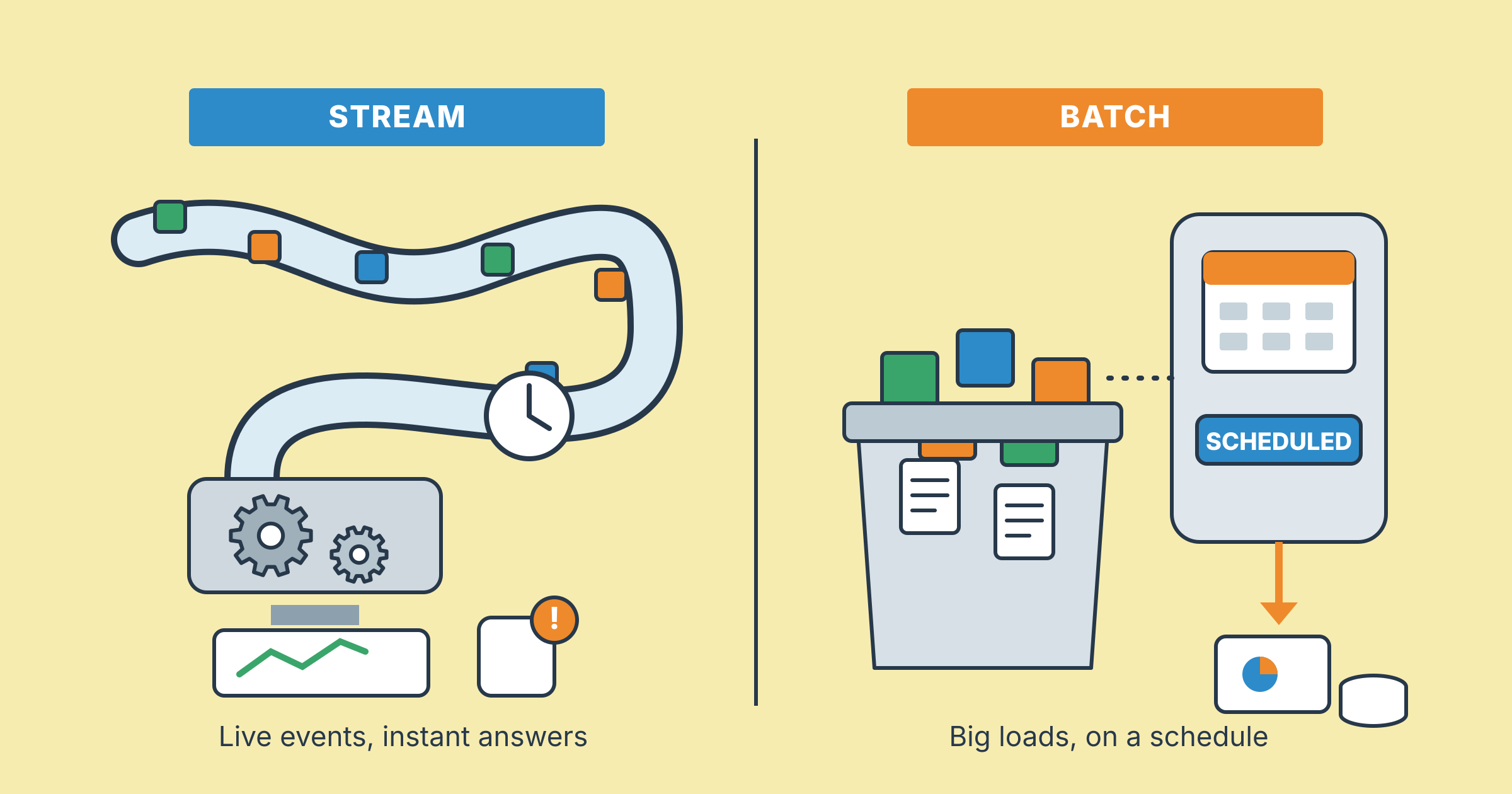
Begin with a small, documented dataset. Establish which customer identifier is authoritative, how duplicate events are handled and who can access sensitive fields. Decide whether a daily update answers the question or whether a real-time requirement has evidence behind it.
A first delivery might be one reliable report with a known refresh time and a named owner. Once that works, the team can test whether connecting additional platforms adds value. This produces evidence for expansion instead of committing to an ecosystem before its responsibilities are understood.
Document ownership, discovery and access requirements when evaluating data ocean vs data lake proposals.
Six questions to ask before buying or building
- Purpose: Which report, decision or application will use the data, and how will success be measured?
- Freshness: How old can the data be? Who detects a delayed or failed pipeline?
- Ownership: Who defines each dataset and corrects disputed values?
- Discovery: Can a user find the right dataset, understand its lineage and see its limitations?
- Access: Can permissions, masking and retention be enforced across the proposed systems?
- Cost: What happens when query volume, retention or data movement increases?
Ask for a representative demonstration rather than a generic benchmark. Use realistic data shapes, access roles and failure scenarios. Include the effort needed to diagnose a failed import or remove access when someone changes role.
Governance must be designed into the workflow
A catalog entry is useful only if someone maintains it. Define ownership, schema-change handling, quality checks and escalation paths alongside the ingestion pipeline. Give downstream users a way to learn when a dataset is delayed, incomplete or unsuitable for a particular decision.
Retention also needs an operating process. Record why data is kept, where copies exist and how expiry or deletion requirements are applied. A larger connected platform can multiply copies and responsibilities unless these are tracked deliberately.
Choose a design you can operate
For data ocean vs data lake decisions, start with requirements and measurable evidence. A focused lake can be sufficient for a particular workload. A wider ecosystem can be useful when cross-platform discovery and processing solve a demonstrated problem.
Document the definition you adopt and the components that deliver it. Clear ownership and reliable data are more valuable than an ambitious label. To explore a practical analysis environment, see installing Jupyter Notebook on Ubuntu 22.04.
Where each approach fits
A data lake stores raw data cheaply and flexibly, suiting exploration and machine learning. The wider idea of a data ocean spans many lakes, sources and teams, which brings scale and also complexity. Choose based on how many domains and users will share the data.
Governance prevents a swamp
Without catalogues, ownership and quality checks, any lake turns into a swamp. Define metadata standards, access policies and retention rules from day one.
Architecture patterns
Layer data from raw to cleaned to curated, use open table formats where possible and separate storage from compute for flexible scaling. Consider a lakehouse when you need both analytics and governance.
Cost and security
Tier storage, monitor query costs, encrypt data and apply least-privilege access with audit logs.
Readers often ask how data ocean vs data lake fits into a busy schedule, and the honest answer is that data ocean vs data lake works best when it is treated as a steady practice rather than a one-time effort. If you are just starting with data ocean vs data lake, begin small, review what you learn, and return to data ocean vs data lake whenever you need a clear reference. Whatever your experience level, data ocean vs data lake becomes easier once you apply it in real situations and share what you discover with others. In short, data ocean vs data lake rewards patience, curiosity and consistent attention over time.
Frequently asked questions
Is a lake a replacement for a warehouse? Not always; many organisations use both.
How do I avoid duplication? Use a catalogue and clear ownership.
What skills are needed? Data engineering, governance and platform operations.
Key takeaways
- Governance matters as much as storage.
- Layer data by quality.
- Control cost and access early.
References
Keep exploring: See all Linux and developer guides.
Leave a Reply