
NGINX Vulnerability: 10 CVEs Your Team Must Check Now

NGINX CVEs rarely arrive one at a time, and the latest batch proves it: ten advisories landed together, followed days later by an eleventh. If NGINX fronts your websites, APIs or Kubernetes clusters, your team needs a clear list of what changed, which features each flaw depends on and which release closes it. This article gives you exactly that, in plain language, with commands you can run today.
Table of Contents
Why These NGINX CVEs Matter
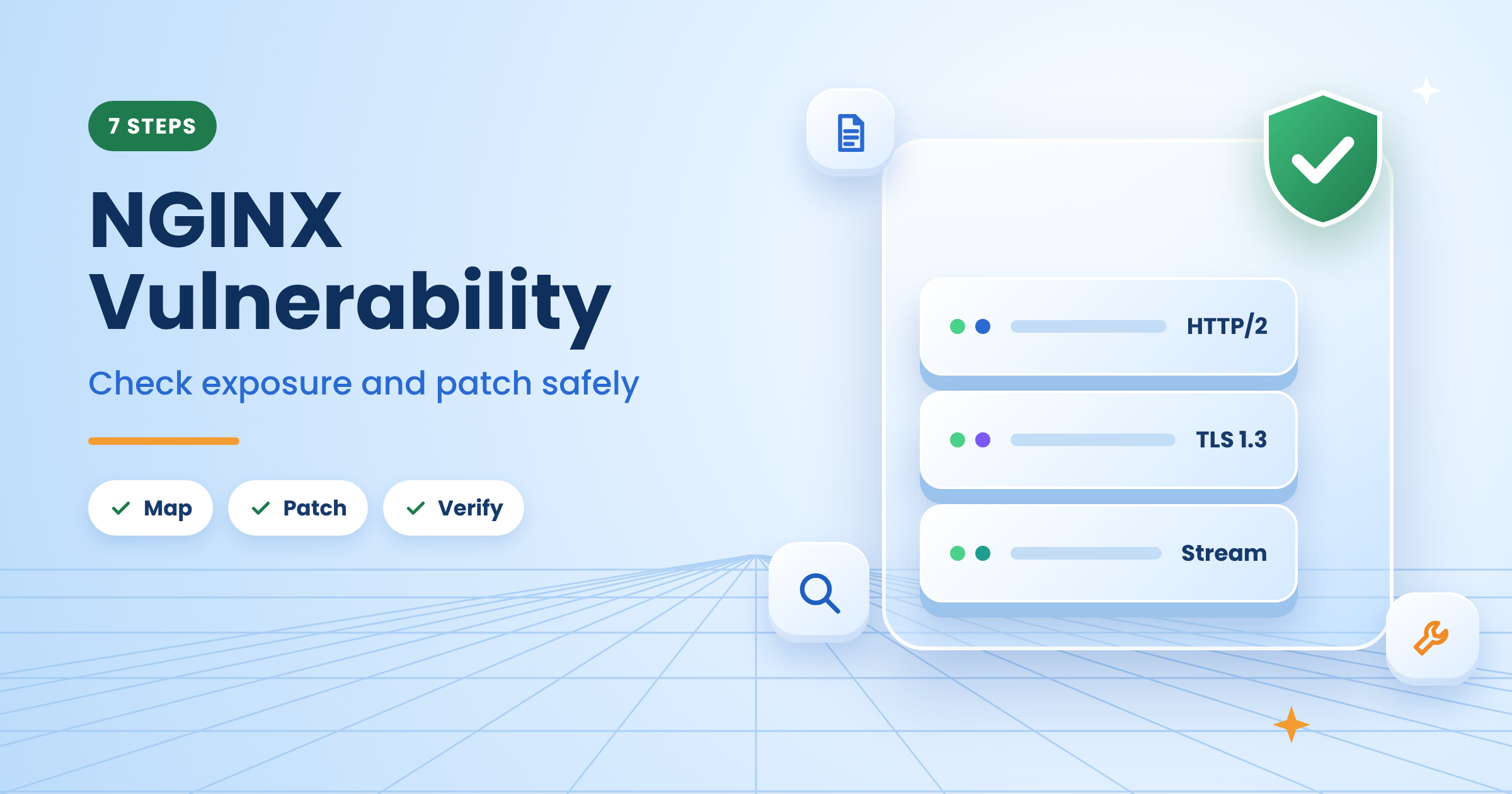
The official NGINX security advisories page now lists ten flaws fixed together in releases 1.30.7 (stable) and 1.31.9 (mainline). They hit different parts of the server: HTTP/2, HTTP/3, TLS 1.3, the resolver, the mail proxy and the stream module. That spread is why I treat these NGINX CVEs as a checklist rather than one emergency.
Five of them are use-after-free or memory-corruption bugs that could, in the worst case, allow code execution. According to the Qualys research team, F5 scored those five at 9.2 under CVSS v4.0 and 8.1 under CVSS v3.1. Code execution needs address randomisation (ASLR) to be disabled or bypassed, and researchers also chained the bugs with a separate, unpatched Linux kernel flaw to reach root. Working exploit code has been published, although it is fiddly to use, so these NGINX CVEs deserve priority even without confirmed attacks in the wild.
The 10 NGINX CVEs at a Glance
Here is the full list in one place. The trigger condition column is the important one: if you have not enabled that feature, the flaw usually cannot reach you.
| # | CVE | Component | Trigger condition | Worst impact |
|---|---|---|---|---|
| 1 | CVE-2026-123007 | HTTP/2 flow control | HTTP/2 enabled | Memory corruption, possible code execution |
| 2 | CVE-2026-123633 | HTTP/2 proxying | HTTP/2 clients proxied to a backend while workers run low on connections | Use-after-free, possible code execution |
| 3 | CVE-2026-121810 | HTTP/3 (QUIC) | HTTP/3 enabled | Use-after-free, possible code execution |
| 4 | CVE-2026-118899 | TLS 1.3 request body | TLS 1.3 on an HTTP listener | Infinite loop, denial of service |
| 5 | CVE-2026-123634 | Resolver | Variable in the proxied server name plus an SSI or mirror subrequest | Use-after-free, possible code execution |
| 6 | CVE-2026-113425 | Mail proxy | NGINX used as a mail proxy | Use-after-free, possible code execution |
| 7 | CVE-2026-120993 | PROXY protocol v2 | Stream SSL with dynamic certificates and PROXY protocol v2 (mainline only) | NULL pointer crash, denial of service |
| 8 | CVE-2026-125283 | alias with try_files | Specific map variable and regex capture setup | Buffer overflow in a worker |
| 9 | CVE-2026-120967 | Stream client certificates | Non-default stream server with ssl_verify_client on | Client certificate check bypass |
| 10 | CVE-2026-123640 | Stream ssl_preread | ssl_preread enabled and a crafted ClientHello | Validation bypass in stream routing |

Teamvoy’s NGINX vulnerability breakdown adds a helpful sanity check: a plain HTTP/1.1 reverse proxy with none of these features is exposed to very few of the ten, while an internet-facing edge with HTTP/2 and TLS 1.3 should assume several are reachable.
Protocol CVEs: HTTP/2, HTTP/3 and TLS 1.3
These are the NGINX CVEs most likely to affect a modern public edge, because HTTP/2 and TLS 1.3 are switched on almost everywhere.
- CVE-2026-123007 (HTTP/2 flow control): the headline bug. Clients that cancel requests at just the right moment can confuse flow-control accounting, so NGINX copies memory it should not. A crash is the likely outcome; code execution is possible under the conditions above.
- CVE-2026-123633 (HTTP/2 use-after-free): needs HTTP/2 from clients, proxying to an upstream and a worker that is running short of connections. Busy reverse proxies are the natural target.
- CVE-2026-121810 (HTTP/3 use-after-free): only matters if you have enabled HTTP/3 over QUIC, which many teams have not yet done.
- CVE-2026-118899 (TLS 1.3 infinite loop): a crafted request body over TLS 1.3 can keep a worker spinning. NGINX rates it major even though it is a denial-of-service bug rather than code execution.
Module CVEs: Resolver, Mail, Stream and Alias
The remaining six NGINX CVEs depend on less common features, which is good news for many teams, but each one is serious where it applies.
- CVE-2026-123634 (resolver): triggered when a proxied server name contains variables and an SSI or mirror subrequest looks up the same name. Dynamic upstreams in Kubernetes are the usual place to look.
- CVE-2026-113425 (mail proxy): affects only servers running the mail module, but the vulnerable code goes back a very long way, so old mail gateways are worth checking.
- CVE-2026-120993 (PROXY protocol v2): limited to recent mainline releases using stream SSL with dynamically loaded certificates plus PROXY protocol v2. Stable users are not affected.
- CVE-2026-125283 (alias with try_files): a buffer overflow that needs a particular mix of alias, try_files, a map variable and regex captures.
- CVE-2026-120967 (stream client certificates): lets a client slip past certificate verification on a non-default stream server by playing with SNI. Mutual-TLS setups in the stream layer should check this first.
- CVE-2026-123640 (ssl_preread): a malformed ClientHello can get past validation in the ssl_preread module, which some teams use to route traffic by hostname.
If you run dynamic upstreams in Kubernetes, my guide to fixing NGINX stale DNS and 404 errors explains how the resolver behaves in clusters, which helps when judging the resolver flaw.
One More: The Newest TLS 1.3 Early Data CVE
Just days after the batch of ten, NGINX published another advisory, CVE-2026-132779, fixed in 1.30.8 and 1.31.10. It only applies when ssl_early_data on; is set for TLS 1.3. A crafted connection can then push one worker into a tight loop that pins a CPU core at 100%, while the worker keeps serving other traffic. It is rated medium, and Red Hat notes that early data is off by default in its builds.
The practical point: if you already patched to 1.30.7 or 1.31.9, you are not quite done. Move to the newer releases, or switch early data off until you can. Doing so disables TLS 1.3 zero round-trip resumption, which most sites will barely notice.

How to Check Your Servers for NGINX CVEs
To check for these NGINX CVEs, start with the build, then the live configuration, then what the internet actually sees. These commands are adapted from the vendor and researcher guidance:
# Is HTTP/2 compiled in?
nginx -V 2>&1 | grep -o -- '--with-http_v2_module'

# Is HTTP/2 or early data switched on in the live config?
sudo nginx -T 2>&1 | grep -nE 'http2|http3|quic|ssl_early_data|ssl_preread|ssl_verify_client|proxy_protocol|mail|stream'

# Does the server accept HTTP/2 from outside?
openssl s_client -connect HOST:443 -servername HOST -alpn h2 </dev/null 2>&1 | grep 'ALPN protocol'

# Is the running binary the one on disk?
ls -l /proc/$(pgrep -o nginx)/exe- Do not trust the version string alone. Distributions often backport fixes under an older number, so compare the full package revision with your vendor’s notice.
- Restart, do not reload. A reload keeps the old binary in memory; a (deleted) marker on the executable link means the patch is not live yet.
- Redeploy containers. The official images moved to fixed tags, but running pods stay on the old build until replaced.
- Check bundled products. Ingress controllers, gateways and WAF appliances that embed NGINX follow their own release schedules.

For the full patching process, including canary rollouts and proving every node is fixed, see my step-by-step guide to handling an NGINX vulnerability.
Risks and Mitigations
The CIS advisory rates the risk high for large and medium organisations. These are the traps I would watch for while working through these NGINX CVEs.
| # | Risk | What it looks like | Mitigation |
|---|---|---|---|
| 1 | Half-finished patch | Servers on 1.30.7 or 1.31.9 still exposed to the early data flaw | Move to 1.30.8 or 1.31.10, or set ssl_early_data off |
| 2 | Stale process | Package updated but the old master is still running | Restart fully and check the executable link |
| 3 | Backport confusion | Distro package shows an old version number | Match the full revision to the vendor security notice |
| 4 | Unmaintained ingress | Community ingress-nginx is archived and gets no fixes | Plan a move to a supported controller |
| 5 | Kernel chain | Worker compromise escalated to root via a kernel bug | Run NGINX unprivileged, segment networks, watch for kernel updates |
| 6 | Lingering workaround | HTTP/2 or early data stays off long after patching | Track each mitigation with an owner and removal date |
A Patch Roadmap for Your Team
Use this roadmap to close all eleven NGINX CVEs in an orderly way, without risking an outage.
| # | Phase | Goal | Key actions |
|---|---|---|---|
| 1 | Inventory | Find every NGINX | List hosts, pods, ingress controllers, appliances and owners |
| 2 | Scope | Map features to CVEs | Grep live configs for HTTP/2, HTTP/3, early data, mail and stream |
| 3 | Prioritise | Fix reachable flaws first | Start with internet-facing HTTP/2 and TLS 1.3 edges |
| 4 | Mitigate | Buy time safely | Disable HTTP/2 or early data only where patching must wait |
| 5 | Patch | Reach the newest release | Upgrade to 1.30.8 or 1.31.10, or the vendor’s fixed revision |
| 6 | Verify | Prove it is live | Confirm every running process and pod reports the fixed build |
| 7 | Harden | Be ready next time | Automate config dumps, version checks and advisory alerts |
FAQ
Which of these NGINX CVEs should I fix first?
Start with CVE-2026-123007 and CVE-2026-123633 on any internet-facing server with HTTP/2, then the TLS 1.3 and HTTP/3 flaws. Feature-specific bugs come next if you use those features.
Are these NGINX CVEs being exploited?
At disclosure there were no confirmed attacks in the wild, but exploit code is public. Treat that as a reason to move quickly, not to relax.
Does upgrading to 1.30.7 or 1.31.9 fix everything?
It fixes the batch of ten. The later early data flaw needs 1.30.8 or 1.31.10, or ssl_early_data turned off.
I use NGINX Plus or an ingress controller. What now?
Follow F5’s advisories for NGINX Plus and your controller’s own release notes. The community ingress-nginx project is archived, so plan a migration.
Final Thoughts
Eleven NGINX CVEs in about a week sounds alarming, but the path through them is clear. Map each flaw to the features you actually run, patch to the newest stable or mainline release, restart properly and verify every instance. Pair that with the broader habits in my critical vulnerability response playbook, and the next advisory will feel like routine maintenance rather than a crisis.

Leave a Reply